By The Compass. November 2nd, 2026.
If you own investments that have increased in value, there may be another way to support The Compass beyond making a cash donation.
A direct gift of eligible publicly traded securities can provide meaningful support for neighbours in south Mississauga while potentially offering tax advantages to the donor.
Instead of selling an investment yourself and then donating the cash, you transfer eligible securities directly to the charity.
For qualifying gifts, this may allow the capital gain associated with the donated security to receive a zero inclusion rate while still allowing the donor to receive an official charitable donation receipt based on the eligible value of the gift.
At The Compass, a gift of securities ultimately supports the same work as other financial donations: helping provide groceries, meals, programs and practical support for neighbours in South Mississauga.
This article provides general information only. Your financial or tax advisor can help determine whether a securities donation makes sense for your circumstances.
A gift of securities is a non-cash charitable donation in which an investment is transferred directly to a charity rather than sold first.
Eligible property can include certain:
The CRA has specific rules governing which securities qualify for favourable capital-gains treatment, so your broker or financial advisor should confirm whether a particular holding is eligible
For many donors, the most familiar example is a publicly traded stock that has increased in value since it was purchased.
The difference comes down to how the investment reaches the charity.
Imagine you purchased shares several years ago and they are now worth considerably more than you originally paid.
You could:
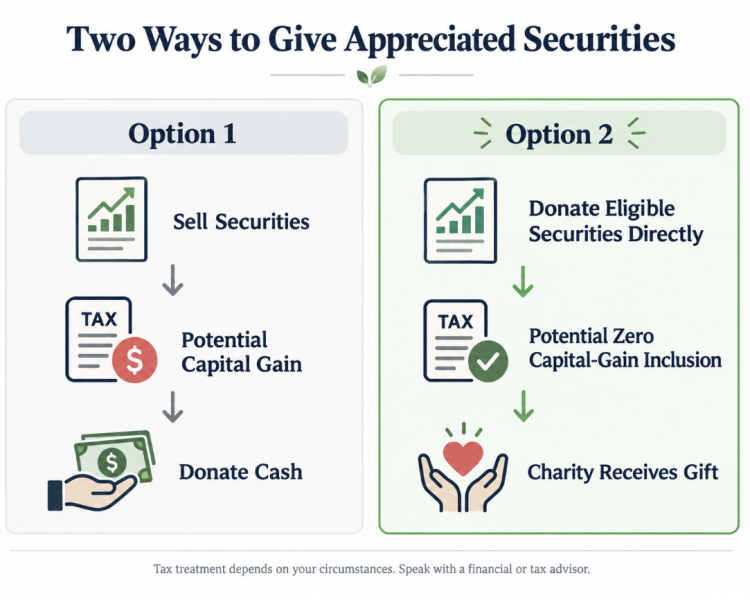
Option | What Happens |
Sell the investment and donate cash | You sell the security yourself. A capital gain may arise before you make the cash donation. |
Donate eligible securities directly | You transfer the investment itself to the charity. Qualifying securities may receive a zero capital-gains inclusion rate. |
That can make a direct securities donation more tax-efficient than selling an appreciated investment first and donating the proceeds.
You still receive a charitable tax receipt, and it’s issued for the full fair market value of the shares on the day we receive them, not just what you originally paid for them.
In practice, that often means a gift of securities costs you less, after tax, than writing a cheque for the same dollar amount, while The Compass receives the full value either way.
The exact result depends on the investment, its adjusted cost base and the donor’s own tax circumstances, which is why professional advice is important.
A publicly traded security donated to a charity is considered a non-cash gift.
For publicly traded shares, the CRA allows a charity to issue an official donation receipt based on the fair market value of the gift on the date it is donated. The date of donation is generally when ownership of the shares transfers to the charity.
The CRA notes that, for shares listed on a designated stock exchange, the closing bid price on the date received may generally be used to establish fair market value, although another reasonable valuation method may sometimes be more appropriate.
This means the donation receipt is not simply based on what you originally paid for the investment.
It reflects the eligible value of the property donated, subject to CRA receipting rules.
The process is usually straightforward, but it involves both The Compass and your financial institution.
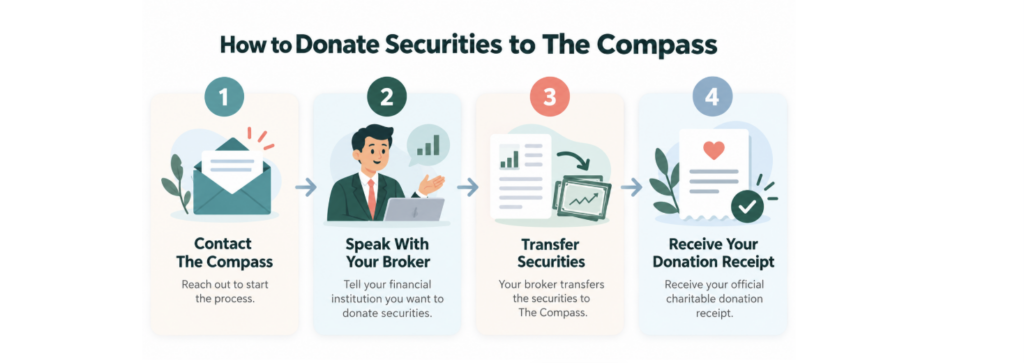
1. Contact The Compass: Before initiating the transfer, contact The Compass so we know that a securities donation is coming and can provide the information required to complete it.
Email: treasurer@thecompass.ca
Providing your name, contact information and basic details about the proposed security can also make it easier to identify your gift once it arrives.
2. Contact your broker or financial institution: Tell your advisor or broker that you would like to make an in-kind charitable donation of securities.
They will normally require transfer information for the receiving account.
Do not sell the investment yourself if your intention is to make a direct securities donation. Selling first changes the transaction from a gift of securities into a cash donation.
3. Transfer the securities: Securities transfers aren’t instant. Depending on your broker, this can take anywhere from a few days to a couple of weeks, which matters if you’re aiming for a receipt dated in a specific tax year.
The donation is generally considered made when ownership of the securities has transferred to the charity.
4. Receive your official donation receipt: Once the donation has been received and the eligible fair market value established, an official charitable donation receipt can be issued according to applicable CRA requirements.
If receiving a charitable donation receipt for 2026 is important to your tax planning, start the process before the final days of December.
Unlike an online cash donation, a securities transfer may involve multiple financial institutions and is not necessarily completed the same day it is requested.
Because settlement isn’t instant, a gift of securities started in the final days of December can easily land in January instead, which pushes the receipt into the following tax year.
For receipting purposes, what matters is when the charity actually receives ownership of the securities, not simply when you ask your broker to begin the transfer.
Do not rely on a last-minute transfer if the tax year of the receipt matters to you.
A securities donation may begin in an investment account, but its impact is local.
The Compass is a registered charity and food bank and community outreach centre serving south Mississauga. Financial support helps sustain food assistance and other community services for neighbours experiencing food insecurity. The Compass’ registered charitable number is 86235 2754 RR0001, under its legal name Lakeshore Community Outreach Centre Inc.
Support can help make possible:
For some donors, an online financial gift is the easiest way to contribute.
For others who already own appreciated investments, a gift of securities can provide another way to turn existing assets into meaningful local support.
Not necessarily.
Both are valuable ways to support The Compass.
A cash donation may be the simplest option for many people. A securities donation may be worth exploring if you:
The best giving method depends on your circumstances and goals.
A financial or tax advisor can help you compare the options before making your decision.
You can, but it is a different transaction. If you sell an appreciated security yourself, you may realize a taxable capital gain before donating the resulting cash.
With a qualifying direct donation, the security itself is transferred to the charity, and eligible gains may qualify for a zero inclusion rate.
That distinction is one of the main reasons donors with appreciated securities may want to explore a direct transfer before selling.
Three conversations can help make the process smooth.
The Compass: Contact us before beginning the transfer so we can provide the required receiving information and know to expect your gift.
Your Broker or Financial Institution: Your financial institution will handle the transfer of the securities.
Your Financial or Tax Advisor: Your advisor can explain how a securities donation may affect your particular tax situation and financial plan.
The Compass can explain how to make the gift, but cannot provide personal financial, investment or tax advice.
A gift of securities can be a meaningful way to support The Compass while making thoughtful use of investments you already own.
If you are considering donating stocks, mutual fund units or other eligible securities, start by contacting us before initiating the transfer.
Email: treasurer@thecompass.ca
We can provide the information needed to begin the transfer.
Can corporations donate publicly traded securities to charity?
Businesses can also make charitable gifts, but corporate tax treatment differs from the charitable tax credit available to individuals. Speak with your accountant or tax advisor before arranging a corporate securities donation.
Can securities held in a joint account be donated?
Potentially, but ownership and authorization requirements can depend on the account. Contact your financial institution before starting the transfer and make sure The Compass has the correct donor information for receipting.
Can I donate securities from an investment account outside Canada?
It may be possible depending on the security, exchange, financial institution and receiving arrangements. Contact The Compass and your broker before initiating an international transfer.
Can I make a securities donation in memory or honour of someone?
If you would like your gift recognized in memory or in honour of someone, let The Compass know when arranging the transfer so your wishes can be recorded appropriately.
What happens if the value of my securities changes during the transfer?
Market values can move between the day a transfer is initiated and the day the charity receives the securities. The official receipt is based on the eligible fair market value when the gift is made according to CRA rules, rather than the value on the day you first requested the transfer.
How is my tax receipt amount calculated for a gift of securities?
Your receipt reflects the fair market value of the securities on the date they’re received in The Compass’s brokerage account, not the price you originally paid for them.
Is there a minimum amount for a securities donation?
There’s no strict minimum, though because there’s some administrative work involved in processing a transfer, it tends to make the most sense for gifts of a meaningful size. If you’re unsure whether it’s worth it for your situation, reach out and we can talk it through.