
By The Compass. September 9th, 2026.
Eligible monetary donations to a registered Canadian charity can generally qualify for a charitable donation tax credit when you receive an official donation receipt. The Compass Food Bank & Outreach Centre is a registered charity and currently provides tax receipts for monetary donations of $20 or more. Food donations, securities, fundraising purchases and checkout donations can be treated differently, so understanding a few CRA rules can help you choose the right way to give and keep the documentation you need.
If you have ever wanted to support a food bank but wondered what happens at tax time, you are not alone.
Can you claim your donation? What should be on the receipt? Does a bag of groceries count the same way as a cash donation? What happens when you add $2 to your grocery bill for charity?
The answers are fairly straightforward once you separate making a charitable gift from claiming the charitable donation tax credit.
Here is what Canadian donors should know before giving to The Compass.
People commonly describe charitable donations as “tax deductible,” but that is not quite how it works for most individual Canadian taxpayers.
Individuals generally receive a non-refundable charitable donation tax credit based on the eligible amount of donations made to registered charities and other qualified ones.
A deduction normally reduces taxable income. A tax credit reduces tax otherwise payable, subject to the applicable federal and provincial or territorial rules.
The Compass is a registered Canadian charity:
Registered name: Lakeshore Community Outreach Centre Inc.
Charitable Registration Number: 86235 2754 RR0001
The Compass currently provides official tax receipts for monetary donations of $20 or more.
An eligible donation to The Compass may qualify for the charitable donation tax credit when CRA requirements are met and you have an official donation receipt.
Not every payment made to a charity automatically qualifies for a receipt for the full amount.
For a straightforward monetary gift, the process is simple. You voluntarily give money to the registered charity and receive nothing of significant value in return.
Things become different when the donor receives a benefit.
For example, if someone pays to attend a fundraising event and receives a meal, entertainment or other benefit, the entire ticket price may not qualify as an eligible charitable gift. The value of that benefit, known by CRA as an advantage, can affect the amount that appears as eligible on the donation receipt.
The same principle can apply to charity auctions and certain fundraising purchases.
This is why there is a difference between:
“I gave The Compass $100.”
and
“I spent $100 at a charitable fundraiser.”
Both can support important work, but they do not necessarily receive the same tax treatment.
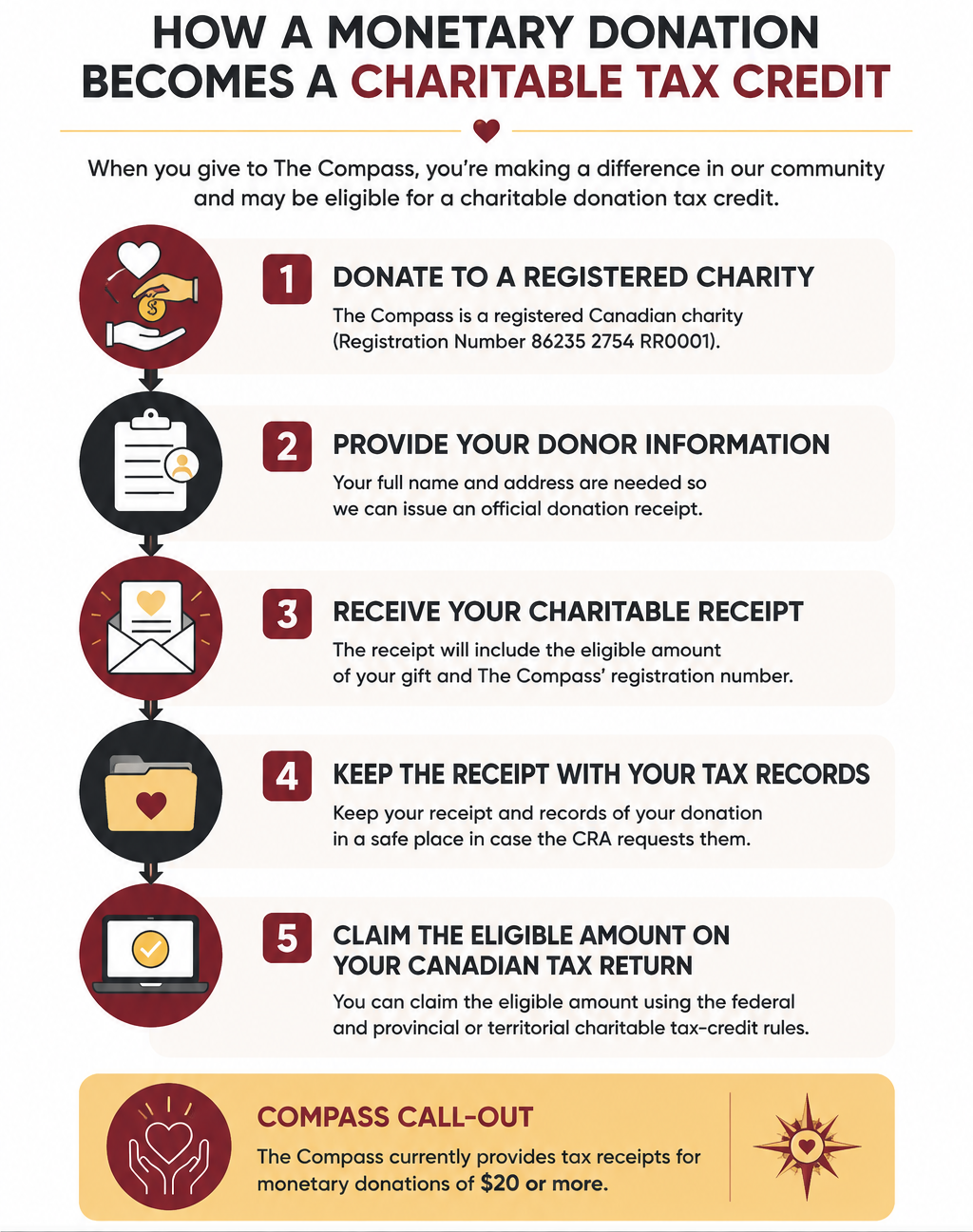
A legitimate charitable receipt contains specific information required by CRA.
For a cash donation, this generally includes:
CRA also requires its name and website information to appear on official receipts.
This is one reason charities ask for donor contact information even when someone would otherwise be comfortable giving anonymously.
If you want to claim the charitable tax credit, the charity needs enough information to issue a valid receipt to the true donor.
The Compass currently offers several ways to make monetary donations.
Donors can give through The Compass’ secure online donation option.
E-transfers can be sent to: treasurer@thecompass.ca
The Compass asks donors to include their full name, address and phone number in the transfer message so the organization can issue the appropriate receipt.
Cheques can be mailed to:
The Compass Food Bank & Outreach Centre
427 Lakeshore Rd E
Mississauga, ON L5G 1H8
Cheques should currently be made payable to The Compass or Lakeshore Community Outreach Centre Inc.
For all of these monetary donation methods, The Compass’ current policy is to provide a tax receipt for gifts of $20 or more.
There is no universal Canadian rule requiring every charity to use the same minimum receiving threshold, which is why donors should check the policy of the organization they are supporting.
CRA generally allows an individual to claim eligible charitable donations up to 75% of net income for the year, although special rules can apply to certain types of gifts and circumstances.
The charitable donation tax credit uses both federal and provincial or territorial calculations.
In general, there is:
Because those rates can change and your final benefit depends on your income and province, it is better not to assume that donating a particular amount will automatically generate a specific refund.
If you want to know exactly how a donation would affect your personal return, CRA’s charitable donation calculator or a qualified tax professional is a better source than a general estimate.
Yes.
Eligible charitable gifts do not always need to be claimed immediately. CRA generally allows unused charitable donations to be carried forward for up to five years.
That can give donors some flexibility over when they claim their charitable tax credits.
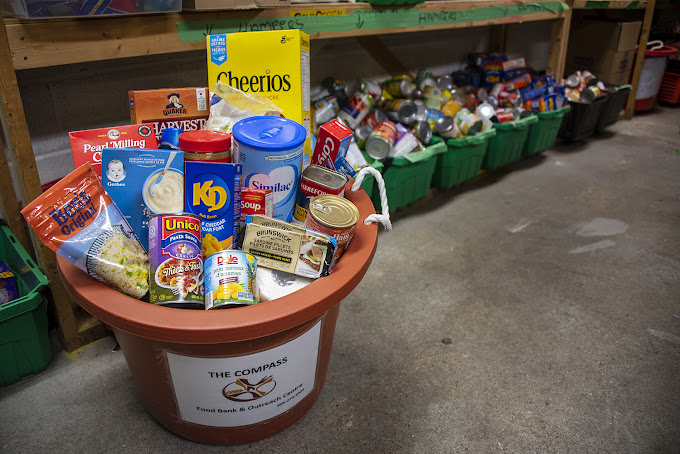
Food donations are incredibly valuable to The Compass, but donating groceries is different from making a monetary donation.
CRA treats donated property as a non-cash gift, sometimes called a gift in kind.
A registered charity can potentially issue an official receipt for an eligible non-cash gift when the property’s fair market value can be properly established and the other receiving requirements are satisfied.
If the fair market value cannot be determined, CRA says an official donation receipt cannot be issued.
That means an individual dropping off tuna, pasta, cereal or a bag of groceries should not automatically expect a tax receipt.
For significant corporate, commercial or bulk donations, the situation may be different. Businesses planning a large food donation should contact The Compass before delivery to confirm:
You do not have to think of this as an either-or decision.
Food donations provide useful products directly to The Compass.
Financial donations provide something different: flexibility.
The Compass explains that donor funds help provide foods such as fresh produce, dairy and frozen protein, along with other essential support. Money can also help the team purchase exactly what is running low rather than waiting for a specific product to be donated.
This is one of the most misunderstood questions about charitable giving.
When a grocery store asks customers to add a charitable donation at checkout, the retailer does not become the donor simply because it collects the money.
CRA specifically confirms that the individual customers are the true donors. The retailer cannot claim a charitable donation receipt for money it merely collected from customers.
The complication is receiving.
To issue an official receipt, the charity generally needs information identifying the true donor. A small anonymous checkout donation may not provide enough information to do that.
So the practical answer is:
Your $1 or $2 checkout contribution is still a charitable donation, but you should not assume you will receive an individual tax receipt unless the checkout program specifically provides one.
That is quite different from the common myth that retailers collect customer donations and then claim the charitable tax credit themselves.
The Compass’ recurring giving program is called the Nourishing Circle.
Monthly giving is worth considering if you prefer to spread your charitable giving throughout the year rather than making one larger contribution.
The Compass has also explained why this form of giving is particularly valuable operationally. Donations tend to be stronger around the holiday season, while community need continues during quieter months. Recurring contributions provide a steadier source of support for food and hygiene products throughout the year.
For donors, recurring giving can also simplify recordkeeping because multiple gifts are connected through the same giving arrangement.
For donors with investment portfolios, publicly traded securities are another giving option.
The Compass accepts inquiries about securities donations.
The tax treatment of securities can differ significantly from simply selling an investment and donating the cash, particularly where accrued capital gains are involved.
Because those decisions depend on the investment, its cost base and the donor’s tax circumstances, this is one area where professional financial or tax advice is particularly useful.
For information about donating securities to The Compass: melinda@thecompass.ca
Before finishing your donation, it is worth checking your workplace benefits.
Some employers offer:
The Compass specifically encourages donors to check with their Human Resources team to see whether their contribution can be matched.
A matching program may allow the same personal contribution to generate additional support for food assistance in south Mississauga.
Taxes explain how a charitable donation is recorded.
They do not explain why the donation matters.
The Compass is a food bank and community outreach centre serving south Mississauga. Donations help provide weekly groceries, nutritious foods and practical support for local individuals and families experiencing food insecurity.
The Compass’ approach is also centred on dignity. Its donation information describes a welcoming, judgment-free environment where neighbours can receive support while preserving their sense of self-worth.
That is ultimately what a charitable donation supports.
The receipt matters at tax time.
The food, dignity and community connection matter every week.
“Being a Nourishing Circle donor means I’m part of something steady and dependable, just like the support The Compass provides.”
~ Donor

Can my spouse or common-law partner claim my charitable donation?
CRA allows eligible charitable donations made by either spouse or common-law partner to be included when calculating one partner’s charitable donation claim. Depending on the household’s circumstances, combining eligible donations can sometimes be useful.
What should I do if I lose my donation receipt?
Contact the charity that issued it. CRA advises donors to request a replacement when a receipt is lost or contains an error.
Can a receipt be issued in someone else’s name?
Generally, the official receipt must identify the true donor, meaning the individual or organization that actually made the gift. A charity cannot simply issue the receipt in another person’s name for convenience.
Do raffle tickets qualify for charitable donation receipts?
Paying for a raffle ticket is not the same as making a straightforward charitable gift because the purchaser receives a chance to win something in return. Charitable receiving rules depend on whether an eligible gift exists after considering the value of any advantage received.
Can I receive a receipt for donating my professional services?
Generally, a service itself is not considered a gift of property for charitable receiving purposes. CRA states that charities cannot issue official donation receipts simply for services provided to them.
When should I expect my charitable donation receipt?
Timing varies by organization. CRA notes that some charities issue receipts throughout the year while others provide one cumulative receipt after year-end. If a charity agreed to provide a receipt and you have not received it, contact the organization directly.
There are several ways to make an impact, depending on what works best for you.
Make a monetary donation: https://thecompass.ca/donate-funds/#donateonline
Become a monthly donor: https://thecompass.ca/donate-funds-monthly/
Donate food: https://thecompass.ca/donate-food/
Questions about receipts, securities or other giving options?
https://thecompass.ca/contact/